Dispensationalism Makes Sense to an Engineer
Why a framework-minded IT veteran finds dispensational theology to be the most logical way to read the Bible — and why the early church fathers saw it long before Darby and Scofield.
I’ve spent thirty years in IT. I think in systems, frameworks, and architecture. When I look at a problem, I instinctively ask: what’s the structure? What are the layers? How do the pieces fit together?
So when I read the Bible — really read it, not just the verses highlighted in a sermon — I kept running into the same question: why does God seem to deal with people so differently across different periods of history? Why does He give Adam one set of instructions, Noah another, Moses a completely different system, and then Paul comes along and says half of that system no longer applies?
For years, that inconsistency bothered me. Then I discovered that there’s a theological framework that not only explains it but makes the entire Bible click into place like a well-designed system architecture.
It’s called dispensationalism. And to an engineer’s brain, it’s the most logical way to read Scripture.
What Is Dispensationalism?
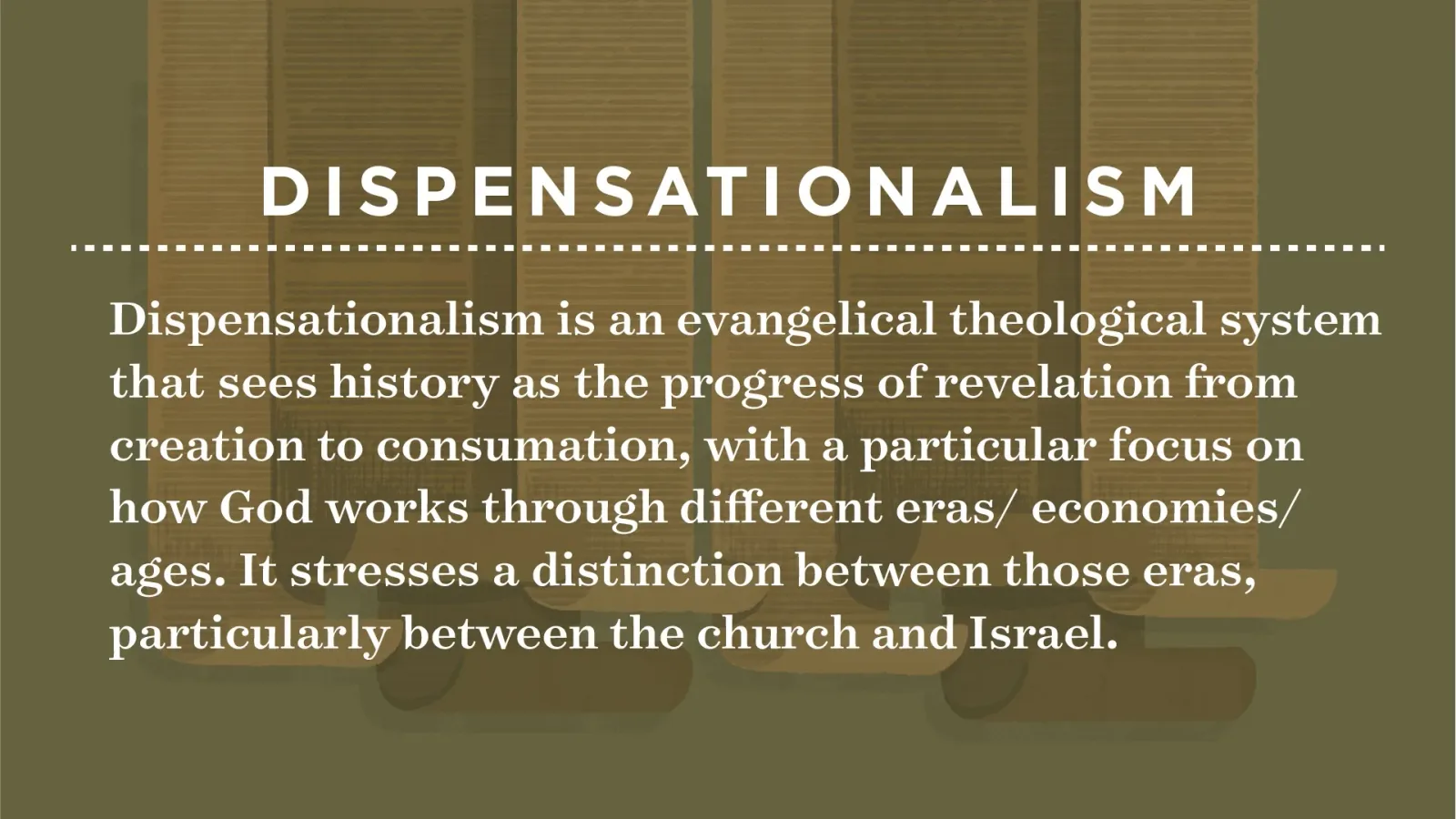
At its core, dispensationalism is the recognition that God has administered His relationship with humanity through distinct phases — called dispensations — each with its own set of responsibilities, tests, and outcomes.
Think of it like software versioning. The underlying codebase (God’s character and purpose) never changes, but the interface — how humans are expected to interact with God — gets updated across major releases:
- Innocence — Adam and Eve in the Garden. One rule. They broke it.
- Conscience — After the Fall through the Flood. Humanity governed by inner moral awareness. They failed spectacularly.
- Civil Government — Post-Flood to Babel. God delegates authority to human governance. Babel happens.
- Promise — Abraham through Moses. God works through a chosen family line based on covenant promises.
- Law — Moses through the Cross. A formal system of 613 commandments governing Israel’s national and spiritual life.
- Grace — The Cross through the present age. Salvation by faith through Christ, not by works of the Law.
- Millennial Kingdom — Christ’s future literal thousand-year reign on earth.
Each dispensation isn’t a different plan of salvation — God has always saved by grace through faith. But the stewardship responsibilities given to humanity change. The rules of engagement update. The API, if you will, gets a new version.
This Isn’t a Modern Invention
One of the biggest misconceptions about dispensationalism is that John Nelson Darby invented it in the 1830s. Darby systematized it, yes. C.I. Scofield popularized it through his 1909 Reference Bible. But the core ideas go back to the earliest centuries of the church.
Clement of Alexandria (c. 150–220 AD) was one of the earliest writers to explicitly recognize dispensations in God’s governance of humanity. He viewed history as divided into distinct stages of divine administration — not one flat, unchanging program, but a progressive unfolding.
Justin Martyr (c. 100–165 AD) affirmed a rebuilt Jerusalem and a literal thousand-year reign of Christ based on straightforward prophetic readings. In his Dialogue with Trypho, he laid out what we’d now call a premillennial view — the same eschatological framework dispensationalism builds on.
Irenaeus (c. 130–202 AD) described God’s plan as progressing through distinct covenantal arrangements, with humanity being gradually prepared for full communion with God. He saw the Old and New Testaments not as contradictions but as stages in a single unfolding plan.
Tertullian (c. 155–220 AD) and Papias (d. c. 155 AD) both held to a future earthly kingdom — a physical, literal millennium where Christ reigns on earth. This wasn’t metaphor to them. It was the plain reading of Revelation 20.
Even Augustine (354–430 AD), who ultimately shifted toward amillennialism (no literal millennium), still referenced “dispensations” as distinct ways God executes His plan through history. He recognized the structural divisions even as he reinterpreted the eschatology.
The point is this: the early church fathers — the people closest in time to the apostles — saw these divisions in Scripture. They read prophecy literally. They expected a future kingdom. Darby didn’t invent dispensationalism. He organized what was already there.
Why It Makes Sense to an Engineer
Here’s why this framework resonates with how I think:
It respects the data
Engineers don’t ignore anomalies. When something doesn’t fit the model, you don’t pretend it’s not there — you update the model. The Bible contains obvious shifts in how God interacts with people. Dispensationalism accounts for those shifts instead of hand-waving them away.
Why did God command animal sacrifices under Moses but Paul says they’re obsolete? Why did God give Israel a theocratic government but tell the church to submit to secular authorities? Why does Jesus tell His disciples to go “only to the lost sheep of Israel” in Matthew 10 but then commission them to “all nations” in Matthew 28?
These aren’t contradictions. They’re version changes. Different dispensations, different instructions, same God.
It takes the text at face value
I’m an engineer, not a poet. When I read documentation, I expect it to mean what it says. When God tells Abraham “I will give to you and your descendants this land” in Genesis, I don’t see a reason to spiritualize that into something it doesn’t say. When Revelation describes a thousand-year reign, I take the number at face value unless the text itself signals otherwise.
Dispensationalism’s commitment to literal, historical-grammatical interpretation aligns with how I process information. Read the text. Understand the context. Accept what it says.
It distinguishes Israel and the Church
This is probably the most important distinctive, and it’s the one that made everything click for me.
Israel and the Church are not the same entity. God made specific, unconditional promises to Abraham and his descendants — land, nation, blessing — that have never been fully fulfilled. Those promises don’t get transferred to the Church. They still belong to Israel, and they’ll be fulfilled in the future kingdom.
The Church is something new. Paul calls it a “mystery” — something hidden in previous ages and revealed in his time. The Church has its own calling, its own destiny, and its own relationship with God. Confusing the two leads to theological chaos. Distinguishing them makes the whole Bible make sense.
It provides a coherent system architecture
When I design a system, every component needs to have a clear purpose and a defined relationship to other components. Dispensationalism gives the Bible that kind of architecture:
- Old Testament prophecy → mostly about Israel’s future, still awaiting fulfillment
- The Gospels → a transitional period where Jesus offers the Kingdom to Israel
- Acts → the transition from Israel’s program to the Church age
- Paul’s Epistles → the Church’s operating manual for the current dispensation
- Revelation → the roadmap for what comes next — tribulation, kingdom, eternity
Every book has a context. Every passage has an audience. Every command has a dispensational setting. You stop trying to force square pegs into round holes.
The Bible Doesn’t Make Sense to Me Any Other Way
I’ll be direct about this: I have tried other frameworks. I’ve sat under covenant theology. I’ve heard the amillennial arguments. I’ve read the progressive covenantalists. And every time, I hit the same wall — they require me to allegorize plain language, transfer promises meant for Israel to the Church, and ignore the obvious structural shifts in how God deals with humanity across the biblical timeline.
I can’t do that. My brain won’t let me. When I read the text plainly and let it say what it says, dispensationalism is what emerges. Not because Darby told me so, but because Clement, Justin Martyr, Irenaeus, and Tertullian saw the same thing in the first and second centuries — long before anyone formalized it into a system.
The Bible is a complex document written over roughly 1,500 years by dozens of authors across multiple languages and cultures. It needs a framework to hold it together coherently. For me, dispensationalism is that framework. It respects the text, accounts for the data, and provides an architecture that actually works.
If you’re an engineer, a systems thinker, or just someone who needs things to make logical sense — and you’ve been struggling with why the Bible seems to say different things in different places — I’d encourage you to look into dispensationalism. Not as a denomination or a political position, but as an interpretive framework.
It might be the lens that finally makes everything click.
Further Reading
- The Scofield Reference Bible — C.I. Scofield’s annotated Bible that brought dispensationalism to mainstream American Christianity
- Things to Come by J. Dwight Pentecost — the most comprehensive academic treatment of dispensational eschatology
- Dispensationalism by Charles Ryrie — a clear, accessible introduction to the framework
- Correctly Dividing the Word of Truth by C.I. Scofield — a short pamphlet that lays out the basic principles
- Dialogue with Trypho by Justin Martyr — read the early church father’s own words on prophecy and the future kingdom
Agree? Disagree? I’d love to hear your perspective in the comments. This is one of those topics where iron sharpens iron.